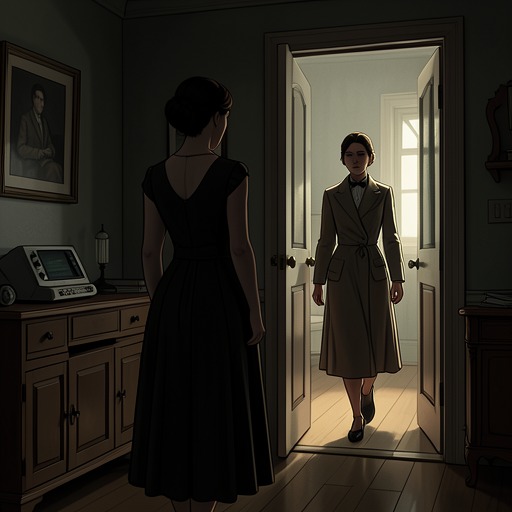
Bernarda’s house
The House of Bernarda AlbaBernarda’s house is the play’s principal setting and more than a backdrop: its rooms, doors, yard, and walls shape where the characters can go and what they can see or hear, while its recurring visual and acoustic features turn domestic space into an image of social confinement. The house is described with precise physical detail, but its stark whiteness, oppressive quiet, and barriers also give it a symbolic reach beyond one family, evoking the restrictive world of the villages of Spain.
Rooms, walls, and routes
At the opening, the audience sees an empty inner room in Bernarda’s house. Thick white walls enclose it; arched doorways are screened by curtains, rush-bottomed chairs furnish the room, and pictures show improbable landscapes of nymphs or legendary kings. It is summer, the stage is hushed, and bells toll. This compact arrangement establishes the house as a place whose physical boundaries and silence are present before its inhabitants appear.
The house’s geography is carefully differentiated. The patio leads to the corral, beyond which stand the stables; a great street door lies at the far end of the yard. The men receive drinks in the patio, while Angustias can listen to them from the great door. The bedrooms are all on the ground floor, with some facing the street. From her room, Adela can see Pepe el Romano turn the corner; Angustias’s room also faces the street, and she speaks with her suitor through its barred window. The same house therefore affords limited sight and speech toward the outside while keeping those encounters separated by thresholds and bars.
The rooms change across the play without losing their essential character. The first act uses an inner room with thick white walls; the second presents another white-walled room, with doors leading to the bedrooms; the third moves to the inner courtyard, where the family eats and light comes from inside the house. The recurring walls, chairs, and doorways make the locations recognisably part of one home, even as the action moves between its interior spaces.
A domestic space under pressure
At the outset, the house’s silence is already oppressive. The stage is empty, and tolling bells are the only sound identified in the opening description. The stillness is not simply an absence of activity: it gives the confined space a weight that anticipates the pressures borne by the young women. The white walls likewise carry two linked meanings. They suggest the daughters’ expected virginity, but also the sameness and unchanging routine of their lives. Repeated arched doorways and bells deepen that sense of repetition, while the enclosed architecture makes the house resemble a prison before any individual conflict has unfolded.
The house’s boundaries do not silence everything outside. In Act Two, tambourines and carrañacas sound as the women listen in silence, and Martirio describes the harvesters as reaping in tongues of fire. In Act Three, a heavy blow against the walls comes from the stallion locked in the stable. Bernarda identifies the source and orders that it be hobbled and let into the yard. The sound carries pressure from the stable into the family’s enclosed living space; the animal remains beyond the immediate room, yet its impact makes the wall itself part of the action.
Later, Bernarda says she is enjoying the silence but cannot see the great thing that Poncia says is happening in the house. She insists that her vigilance can control everything. The claim joins the house’s quiet to Bernarda’s effort to command it: the domestic enclosure is both the instrument of her authority and a space in which events remain difficult for her to perceive. Near the end, Poncia hears the dogs barking, and the Servant suggests someone may have passed the front door. Once again, an offstage sound makes the boundary between the house and the village dramatically active.
From particular home to symbolic setting
The house is presented as a plausible rural residence, with a yard, stable-yard, stables, street-facing bedrooms, and a clear arrangement of routes between them. Its exact geography matters because the action depends on who can observe a doorway, listen from a threshold, or move between the house and the stables. At the same time, the stage settings are selective: their repeated white surfaces, stillness, and enclosed forms gather symbolic force rather than merely reproducing domestic architecture.
The house’s oppressive quiet and thick walls extend beyond the immediate family. The play’s account describes Bernarda’s home as evoking other houses in her village and beyond it, spreading the associations of enclosure to a wider social world. Its importance lies in that double function: it is a specific place through which the characters move, and a stage image of the restrictions that shape their lives. The house makes confinement architectural, while sounds from outside and from within its own outbuildings repeatedly reveal pressures the walls cannot wholly contain.